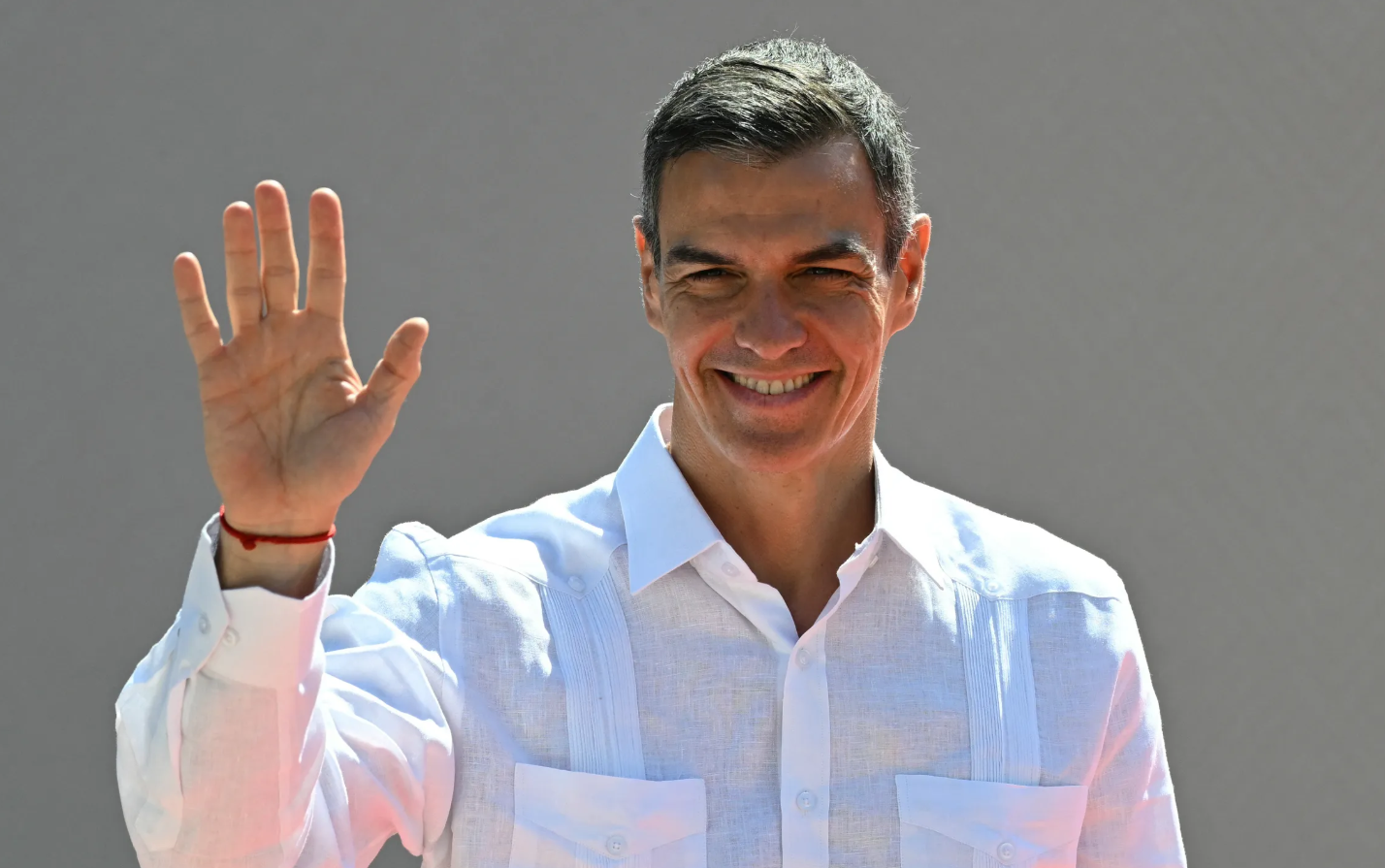

Few contemporary Spanish political careers have experienced as many seemingly definitive moments as that of Pedro Sánchez. At different stages he was considered a finished leader, lost the leadership of his party, left his seat in Congress and then returned to regain control of the PSOE. He then managed to reach the Government Presidency by means of a motion of censure and managed to remain in power through an increasingly fragmented parliamentary scenario. This capacity for political survival has become a fundamental feature of his figure, admired by his followers and criticized by his adversaries.
Born in Madrid on 29 February 1972, Sánchez studied Economic and Business Sciences and later expanded his training in European affairs. Before reaching the first lines of national policy he worked in areas related to European and international institutions and developed academic activity. His political career included a stage as a councilman in Madrid and later as a congressman. In 2014 it first reached the General Secretariat of the Spanish Socialist Workers' Party, starting a stage that would transform both its own career and the internal functioning of the party.
Those first years as a socialist leader were extremely difficult. Spain was emerging from a deep economic crisis, the traditional bipartisan system was under pressure and new forces such as We and Citizens had altered the electoral balance. The PSOE was to compete simultaneously with the People's Party and with emerging parties capable of attracting discontent voters. After complicated electoral results and strong internal conflicts, Sánchez ended up leaving the party leadership in 2016.
What happened later became one of the most well-known policies of Spanish democracy. Sánchez went through the country seeking the support of the socialist militancy and reintroduced himself to the PSOE primaries. Against much of the party's traditional apparatus, he managed to recover the General Secretariat in 2017. The episode strengthened its internal authority and built a narrative of resistance that has since accompanied its political image.
In June 2018 there was another unexpected turn. A sentence related to the Gürtel case seriously weakened the Mariano Rajoy government, and Sánchez filed a motion of censure. The initiative managed to gather the necessary parliamentary support and made Sánchez President of the Government without having previously won a general election as a candidate for the presidency. It was an exceptional event that showed the extent to which the parliamentary fragmentation had transformed Spanish policy.
Since then, Sánchez has had to rule through complex agreements with different political forces. Spain left behind the time when PSOE or Popular Party could relatively often aspire to sufficient majorities to govern with much autonomy. The new reality requires constant negotiations, and that unit of parliamentary partners has been one of the main sources of controversy of their Governments.
During its stage in La Moncloa, Spain had to face extraordinary events. The COVID19 pandemic produced an unprecedented health and economic emergency. The government declared a state of alarm, introduced restrictions and developed programmes to protect companies and workers. As in other European countries, decisions generated intense discussions on proportionality, effectiveness and economic consequences.
The subsequent recovery was conditioned by European funds and an economic transformation that focused on digitization, energy transition and public investment. At the same time, the Russian invasion of Ukraine led to an energy crisis that once again put pressure on Spanish homes. The government defended measures to limit some effects of price increases, while the opposition questioned its economic policy and the growth of public spending.
Social and labour policies also became central elements of Sánchez's project. During their governments, the minimum wage was significantly increased and reforms were adopted in areas such as work, pensions and equality. Their defenders present these measures as evidence of a social-democratic orientation focused on strengthening the protection of workers and households. Its critics argue that some policies increase costs for companies, increase state intervention or generate long-term fiscal risks.
Perhaps no issue has been as politically explosive as the relationship with the Catalan independence parties. The need to build parliamentary majorities led the PSOE to negotiate agreements that its opponents have used to accuse Sánchez of making excessive concessions in order to remain in power. The amnesty law linked to the Catalan conflict became especially one of the major points of political confrontation.
For Sánchez and his allies, the approach sought to reduce the territorial conflict and return the Catalan dispute to the field of political negotiation. For the People's Party, Vox and other critics, the concessions represented a threat to equality before the law and were motivated by parliamentary need. The intensity of this confrontation shows that the territorial question remains one of the fundamental divisions of Spanish politics.
Polarization has marked its presidency. Sánchez has a considerable support base, but it also generates a particularly intense rejection among opposition sectors. This dynamic is not exclusively Spanish; many Western democracies have experienced a growing personalization of politics in which elections become both referendums on specific leaders and debates on programmes.
Its communication and strategic capacity is an important part of its survival. Sánchez has repeatedly demonstrated a willingness to take political risks that other leaders could avoid. Convening elections, rebuilding alliances or changing strategies after a defeat have been part of a career characterized by unexpected movements.
In foreign policy, their governments have tried to maintain a strong European orientation while Spain seeks to expand its influence within the European Union. Relations with Latin America, the Mediterranean and North Africa are also part of a particularly important agenda because of the country's geographical and historical position.
As of 2026, Pedro Sánchez continues to be President of the Government of Spain, a position he has held since June 2018. Its permanence makes its stage one of the most relevant of recent Spanish policy, especially because it has developed during a profound transformation of the party system and in a European context marked by successive crises.
Assessing your legacy will take time. Its supporters highlight social policies, employment, growth, Europeanism and the reduction of tensions in Catalonia. Their opponents focus their criticism on parliamentary alliances, institutional quality, public spending and certain political concessions. As with the long-standing leaders at the centre of power, the personal figure ends up being inseparable from the discussions about the country.
Perhaps the most extraordinary feature of Sánchez is precisely to have turned political survival into a form of leadership. On many occasions it seemed to be in the final end and yet it managed to find a new majority or rebuild its position. This capacity alone does not determine whether its policies were correct, but it explains why Pedro Sánchez has become one of the essential figures to understand the political Spain of the twenty-first century.