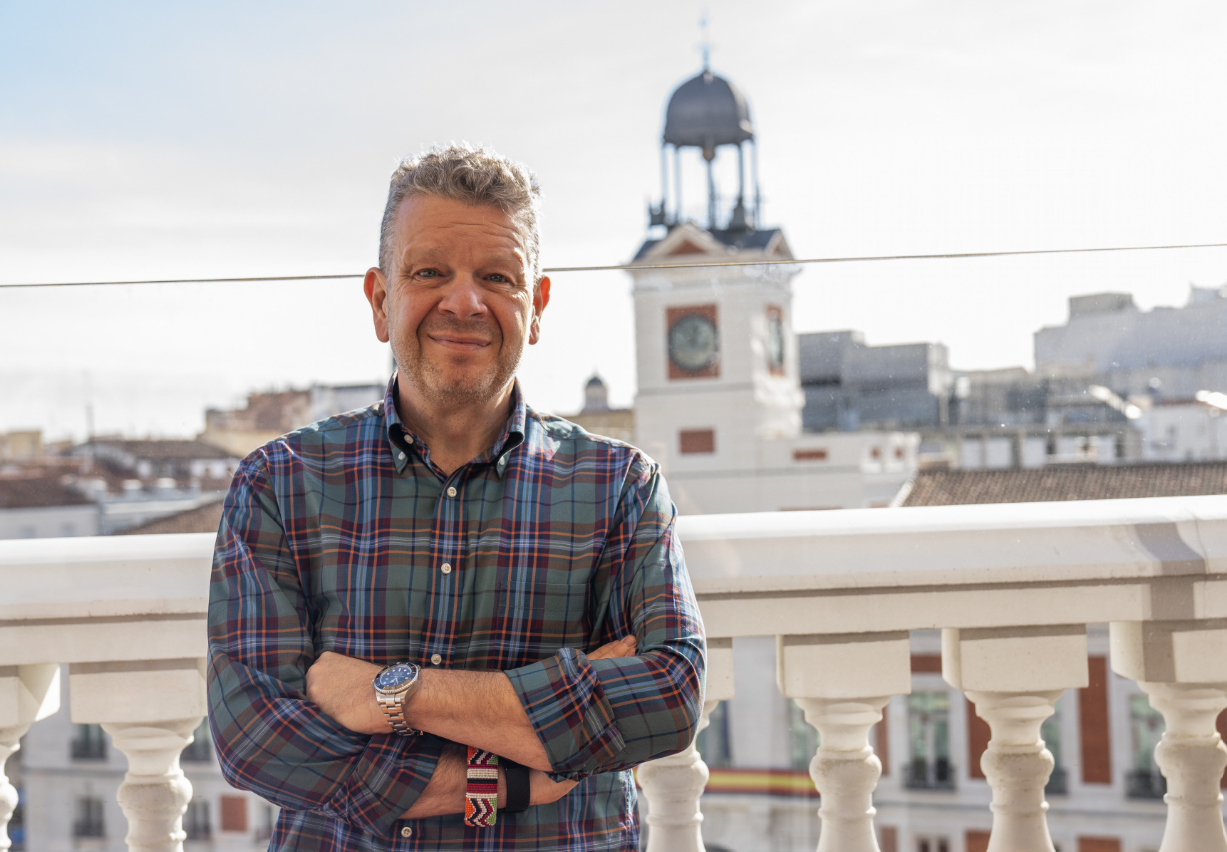

Alberto Chicote has become one of the most recognizable faces of contemporary Spanish cuisine, although defining it only as a cook would be to stay short. Throughout his career he has managed to combine professional cuisine with television, gastronomic outreach and entertainment, building a public personality that goes far beyond the limits of restaurants. For a large part of the Spanish public, its name is inevitably associated with disorganized kitchens, desperate owners and restaurants on the verge of closure, popular images by Nightmare in the kitchen. However, long before becoming a television figure, Chicote had already developed a solid professional career within the Madrid restoration and had begun to draw attention to a form of cooking that combined Spanish products with international influences.
Born in Madrid in 1969, Chicote grew up at a time when Spanish cuisine still did not enjoy the extraordinary international recognition that would reach decades later. His entry into the world of cooking was not initially related to the search for fame or to the television universe. Like many restoration professionals, he started building his experience from daily work in real kitchens, where discipline, speed and ability to maintain constant standards are as important as creativity. The chef's image as a celebrity was still far from becoming the cultural phenomenon we currently know, and the profession developed mainly behind the doors of restaurants.
Over the years, Chicote began to consolidate his own culinary identity. One of the most interesting features of his work was his interest in incorporating Asian influences into Spanish ingredients and traditions. Today it is relatively common to find restaurants that mix Japanese, Latin American, Mediterranean or South-East Asian techniques, but during the early stages of their career this combination had a much more innovative character within the Madrid gastronomic landscape. His proposal helped to place him among a generation of cooks interested in extending the limits of what could be considered contemporary Spanish cuisine.
His work in restaurants such as Nodo and Pan de Lujo especially contributed to building his professional reputation. Chicote developed a kitchen that sought to surprise without completely abandoning the recognizable references for the Spanish comment. This ability to combine familiarity and novelty would subsequently be an important feature of their television personality. Although television needed to simplify some aspects of the profession to make them accessible to millions of viewers, Chicote could talk about cooking from the direct experience of someone who knew the real difficulties of managing a service, organizing a team, controlling costs and keeping quality under pressure.
The great change in his public life came with Nightmare in the kitchen. The format placed Chicote within restaurants with serious problems of management, organization, hygiene, cooking or working relations. Its mission was to identify the causes of business deterioration and to try to make changes that could return it to viability. The formula combined gastronomy with elements of a business transformation program and a reality show, generating situations of tension that quickly attracted public attention.
One of the reasons for the program's success was precisely Chicote's personality. His direct style, his daily language and his obvious frustration at certain situations created an immediately recognizable television figure. He did not appear as a distant chef who offered a master class from a perfect kitchen, but as someone who went into business where practically everything could go wrong. Malorganized cold cameras, incorrectly stored food, unmanageable cards, owners faced with their employees and financial problems became part of a narrative that allowed to understand that a restaurant is much more than the food that finally appears on the plate.
Behind the show there was also an interesting business lesson. Many of the problems shown in Nightmare in the kitchen had little to do with the ability to prepare a specific recipe. An establishment could have a competent cook and still fail due to too extensive a card, poorly planned purchases, lack of leadership, incorrect prices or constant conflicts between team members. The program thus popularized a reality known to professionals in the sector: managing a restaurant requires combining gastronomy, administration, logistics, human resources and customer care.
Chicote's blunt personality inevitably generated divided opinions. For some spectators, their way of facing those responsible for the restaurants was precisely what made the program attractive. Others considered that certain situations were dramatic or that the television format could exaggerate conflicts. This tension exists in virtually any program that combines reality and entertainment. Television needs to build an understandable story within a limited time, while the problems of a real business may have developed for years and have much more complex causes than can be shown on screen.
However, to reduce Chicote's television career only to Nightmare in the kitchen It wouldn't be right either. Over the years it has participated in different formats related to gastronomy, food and entertainment. His presence on television helped to make him a figure able to talk about both professional cuisine and daily eating habits. This evolution reflects a much broader change in Spain over the last few decades: gastronomy ceased to be simply a domestic or professional activity to become a fundamental part of popular culture.
Culinary contest programs, restaurant documentaries, recipe videos and gastronomic content on social networks have transformed the public's relationship with the kitchen. The chefs were no longer known figures mainly within the sector and some began to develop profiles comparable to those of actors, musicians or presenters. Chicote clearly belongs to this generation, although its television identity differs from the sophisticated image associated with other great names of the high kitchen. Its attractiveness is precisely in a more direct and accessible communication.
Another important element of his career has been his interest in food from a perspective that goes beyond restoration. Some of its programmes have investigated products, consumption habits and food industry issues. This type of content is particularly relevant at a time when consumers are increasingly interested in understanding what food contains, how it is produced and what consequences certain choices may have on health and the environment.
Modern food is extremely complex. Supermarkets offer thousands of products, labels include information that is not always easy to interpret and social networks are full of contradictory nutritional advice. In this context, gastronomic communicators can play an important role if they can provide information in an understandable way without reducing complex issues to too simple messages. Chicote has used its visibility to bring some of these debates closer to audiences that would probably never consult specialized publications.
Its relationship with gastronomy also shows how much the concept of chef has changed. For much of the 20th century, the professional success of a cook was measured mainly by the reputation of the restaurants in which he worked. Currently, a chef can simultaneously develop restaurants, television programs, books, social networks, commercial collaborations and educational projects. This diversification can generate criticism of the marketing of the profession, but also allows the gastronomic knowledge to reach much wider public.
Chicote has been able to make the most of this transformation. Their public presence does not depend exclusively on a specific kitchen or a particular restaurant. The public recognizes their personality, their way of speaking and their way of reacting to problems. In terms of communication, it has built an extraordinarily strong personal brand, which explains why it remains a recognizable figure even for people who do not usually follow high gastronomy.
It is also interesting to see how your public image has evolved over time. In its early television stages, much of the appeal was built around confrontation and surprise at extreme situations within restaurants. Over the years, his role was extended to a more general figure of divulge and gastronomic communicator. This evolution is important to maintain a lasting television career, because concrete formats can be exhausted while a personality able to adapt can continue to find new spaces.
The influence of Chicote must also be understood as part of the extraordinary international growth of Spanish cuisine. Over the past few decades, Spain has become a global reference thanks to the work of chefs, restaurants and culinary movements that transformed the international perception of its cuisine. Although Chicote occupies a different space from the chefs most associated with experimental gastronomy and Michelin stars, it is part of the same cultural transformation that made the kitchen one of the great elements of contemporary Spanish identity.
Its specific contribution has been to bring the operation of the restoration closer to millions of people. After watching your programs, it is more difficult to imagine a restaurant simply as a dining room where someone prepares dishes. The viewer discovers the entire system behind it: suppliers, storage, cleaning, organization, leadership, costs, schedules, service and human relationships. Professional cuisine then appears as a much more demanding activity than it may seem from a table.
After decades of working between fires and cameras, Alberto Chicote represents an unusual combination of professional cook and popular communicator. His career shows that technical knowledge can become entertainment without completely disappearing behind the show. It also reflects a time when gastronomy has become a permanent conversation that includes culture, economy, health, tourism and lifestyle. Chicote began his career working in professional kitchens, but ended up becoming one of the people who helped teach the large Spanish public what really happens behind them.